medicalbd সাস্থের সকল খবর।

Bone wax
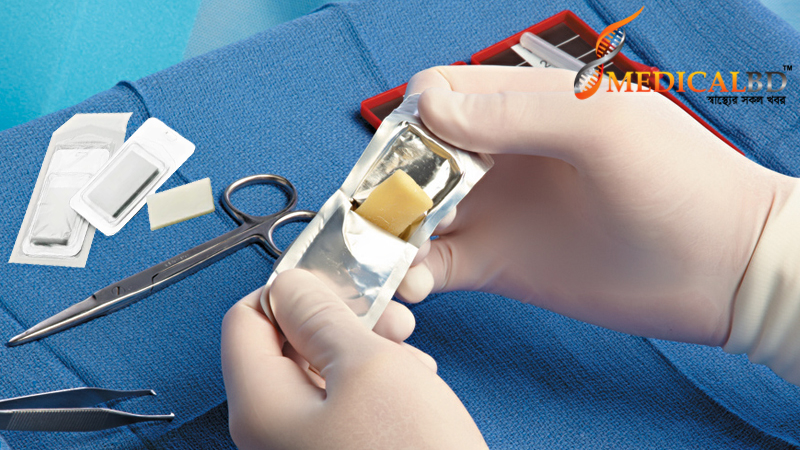
Bone wax is used to help mechanically control bleeding from bone surfaces during surgical procedures. It is made up of beeswax with a softening agent such as paraffin or vasoline and is smeared across the bleeding edge of the bone, blocking the holes and causing immediate bone hemostasis through a tamponade effect.
Bone wax is supplied in sterile sticks, and most often requires softening before it can be applied.
The FDA has recently approved a new water soluble bone hemostasis material called Ostene, which is designed to look and feel like bone wax. This material comprises a sterile mixture of water-soluble alkylene oxide copolymers, derived from ethylene oxide and propylene oxide. These copolymers have a long history in the medical and pharmaceutical fields, and they are considered inert. These compounds are not metabolized, but eliminated from the body unchanged. It is anticipated that with the introduction of these new hemostatic materials, the incidence of surgical bone infections, nonunion and inflammatory complications will decrease with time.
Bone Wax is a sterile mixture of beeswax and isopropyl palmitate, a wax-softening agent. It can achieve local hemostasis of bone by acting as a mechanical (tamponade) barrier.
The issues surrounding bone wax are well documented. There main problems that directly affect bone hemostasis are listed below with selected supporting references. Infection and non-union are particularly dangerous in cardiac surgery. According to the American Heart Association (AHA), the incidence of deep sterna wound infections is 1% – 4%. Of these, up to 25% die, and the rest are subject to a complicated and costly recovery.
Bone wax inhibits bone healing.
Bone wax forms a physical barrier, preventing bone union. In fact, research has shown that where bone wax is present, osteoblasts are absent in bone defects. In defects where bone wax was applied and removed after just 10 minutes, researchers discovered complete inhibition of bone regeneration. For this reason, beeswax is almost never used in areas where bone fusion is critical.
Bone wax increases infection rates.
Beeswax has been proven to significantly impair the bone’s ability to clear bacteria. In the presence of bone wax, the number of bacteria needed to produce osteomyelitis is reduced. In a recent study of infection rates following spinal surgery, surgical site infections occurred in 6 of 42 cases in which bone wax was used, and in only 1 of 72 cases in which it was not used. Bone wax causes inflammation. It remains as a foreign body for many years, causing a giant cell reaction and local inflammation at the site of application. In skull base surgery, bone wax has been reported to cause granuloma formation and CSF fluid leaks.